Killing Prompt-and-Pray: The Harness-First Roadmap
The series finale. Going harness-first is not a subscription or a tooling purchase. It is a five-layer operational shift, and this is the practical roadmap for running it at a real engineering org.
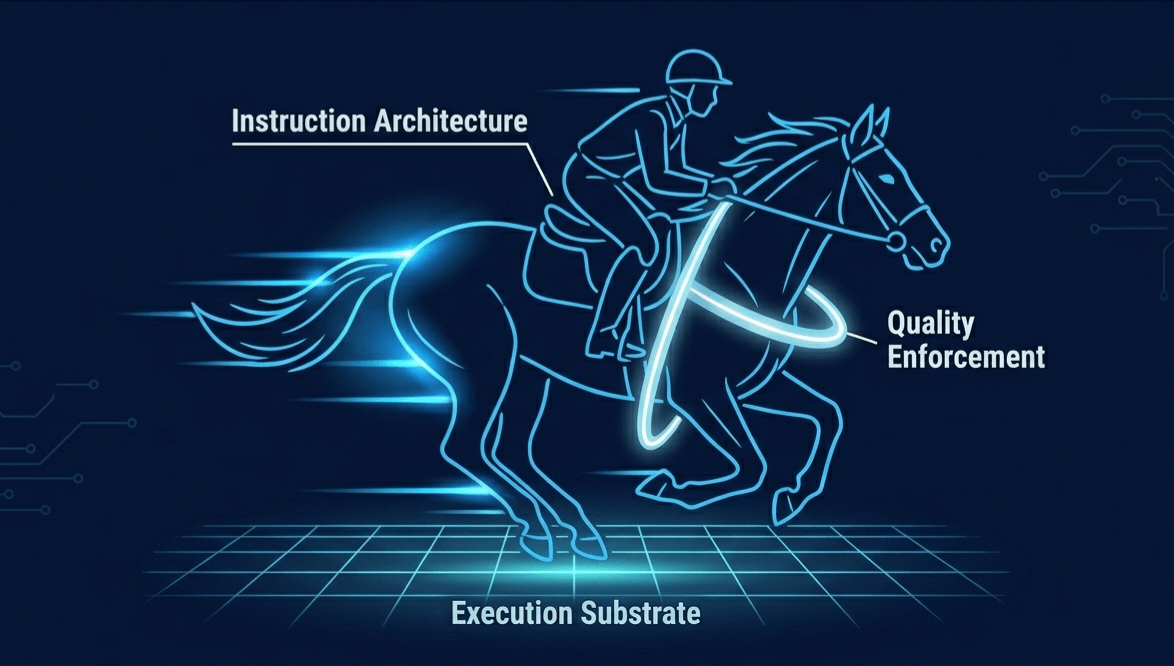
Five posts in, I have spent a lot of words diagnosing failure modes. Architectural drift. Context rot. Security blindness. Each one has a clean mechanical fix, and each fix has a name that sounds good in a blog post. What none of them answer is the only question that actually matters once you close the tab: "Great. So what do I do on Monday?"
This is the Monday post. It is also the last post in this series.
Part 6 is the bridge between the theory and the actual org chart. Between the 6-Layer Shield as a diagram and the 6-Layer Shield as something your build breaks on. Between RIDER as a framework and RIDER as a pipeline stage that blocks a deploy at 2am. And the most important thing I can tell you up front is this: transitioning to a harness-first SDLC is not a tooling purchase. It is not a subscription. It is not a seat license quietly rolled out to every engineer at the all-hands.
Handing out Claude accounts and declaring yourself AI-first is the most expensive way to not transition. You get the cost, the attention tax, the occasional burst of output, and almost none of the throughput multiplier that the OpenAI benchmark in Part 2 actually validated. The multiplier is not in the model. It is in the structure around the model.
That structure is what this post is about. I think of it as five layers, stacked. Each layer is useless without the one beneath it, and each one takes a phase of real, boring, unsexy work to put in place. You do not need to finish all five before you see value. You do need to do them in order, because each layer assumes the previous one already exists.
Layer 1: Instruction Architecture
The first phase of the transition is embarrassingly simple and almost universally skipped. You make the repo the source of truth for how agents should behave. Not the wiki. Not Notion. Not the shared Google Doc that three people maintain and seven people ignore. The repo.
Where this gets misunderstood is in the implementation. The first instinct most teams have is to dump everything they know into a giant AGENTS.md or CLAUDE.md at the root of the project, and then sprinkle smaller copies of the same idea into every subdirectory. It feels thorough. It is also actively counterproductive. Those files get pulled into the context window on every single request, whether the agent needed them or not. You end up paying for ten thousand tokens of architectural philosophy on a task that just wanted to rename a variable. The tax is invisible and constant, and it is the single fastest way to drag your whole harness into the Dumb Zone from Part 4 before the agent has even read its first file.
The fix is to separate two things that look identical from a distance but behave very differently in practice. Always-on instructions are the rules so foundational that the agent must have them in scope at all times. The stack. The commit style. The two or three non-negotiables that, if violated, break the build in ways no linter will catch. These belong in the root AGENTS.md, and the file should be ruthlessly short. If it grows past one screen, you are doing it wrong.
Reference documentation is everything else, and it lives in normal markdown files inside the repo, not in instruction files. A docs/ tree, or co-located README.md files inside each module, or both. Architectural decision records. Domain glossaries. Migration playbooks. Integration quirks. The whole institutional memory you would otherwise lose to Slack archaeology. It is all in the repo. It is all in version control. It is all reviewable in a PR. But none of it is auto-loaded into context.
The agent reaches that documentation the same way a new human engineer would: by searching for it when it becomes relevant. Read, Grep, Glob. The harness gives the agent the tools to find the right doc at the right moment, and the always-on file points the way ("for anything touching payments, read services/payments/README.md first"). On-demand retrieval means the only tokens you pay for are the ones the current task actually needs. A rename touches almost no docs. A migration touches several. The cost scales with the work, not with the size of your knowledge base.
The thing that makes this whole pattern work is the map. The single most valuable section in your AGENTS.md is not the rules. It is the index of where everything else lives. A short, scannable layout of the repo that tells the agent: business logic is under services/, persistence is under repos/, ADRs are under docs/decisions/, runbooks are under docs/runbooks/, integration notes are co-located next to each module as README.md. Five or ten lines, no more. With that map in scope, the agent never has to guess and never has to crawl the tree blindly. It opens the file it needs in one hop. Without the map, on-demand retrieval collapses into a shell-game of find calls and the token savings evaporate. The map is the cheapest, highest-leverage thing you can put in your instruction layer, and it is the part most teams forget to write.
The test for whether your instruction architecture is real is straightforward. If a new human engineer can get productive by reading the repo without asking a colleague for oral tradition, an agent can too. If the only way to know that the payments module cannot depend on analytics is to ask Dave, your instruction layer does not exist yet. It is still in Dave's head. The work of this phase is moving Dave's head into markdown files that already happen to live where the code lives.
This phase is almost entirely writing. It feels like you are not building anything. You are. You are building the substrate that every subsequent layer depends on, and you are doing it without burning a single token until the agent actually needs it.
Layer 2: Quality Enforcement
Once the rules exist in the repo, you need walls that make violations impossible rather than merely discouraged. This is where the 6-Layer Shield from Part 3 stops being a diagram and starts being code your build actually breaks on.
The mechanism is custom linters. Not the off-the-shelf ESLint rules that ship with your framework. Linters written specifically for your architecture, and ideally generated and maintained by agents themselves. The excellent walkthrough at https://www.nxcode.io/resources/news/harness-engineering-complete-guide-ai-agent-codex-2026 goes through the Codex-driven approach in detail. The short version is that you point an agent at your architectural rules and ask it to produce the lint rules that enforce them. You end up with a bespoke rule set that matches your actual structure rather than somebody else's.
The reason this layer comes second is that agents do not read documentation. They hit walls. An agent that reads "do not import the database directly from the UI layer" in an AGENTS.md file has a nonzero probability of doing it anyway when the path of least resistance points that way. An agent whose build fails with a clear error message when it does that has a zero probability. One of these is a suggestion. The other is physics.
Your engineers will complain about the rules at first, for exactly the same reason they complained about TypeScript in 2018. Let them. The alternative is the architectural chaos you already have, except now with a ten-times multiplier on top of it.
Layer 3: Executable Skills
By the time you reach this layer, your agents have rules and walls. What they do not have yet is a clean way to load the knowledge they need for a specific task without blowing up their context window on everything they do not need.
The naive approach is to shove every style guide, every API reference, and every integration quirk into one giant system prompt. This is the fast path to context rot from Part 4, because the agent ends up spending half its reasoning budget wading through instructions that have nothing to do with the task at hand.
The right approach is what the industry is starting to call skills. A skill is a scoped, loadable capability. "How to write a migration for our Postgres schema." "How to instrument a new endpoint with OpenTelemetry." "How to add a feature flag." Each one is a small, self-contained bundle of instructions, examples, and references that the agent pulls in only when the task calls for it.
Skills solve the monolithic-context problem the way modules solved the monolithic-source-file problem decades ago. You stop trying to make one thing do everything. You build many small things, each responsible for one piece of knowledge, loaded on demand. The agent stays in the Smart Zone because its context never has to carry passengers.
The practical work in this phase is inventory and conversion. Walk through the things your senior engineers find themselves explaining over and over. Turn each one into a skill. The return on the work is the conversation you never have to have again, and the consistency of having the canonical answer live in a file instead of in a Slack thread from nine months ago.
Layer 4: Execution Substrate
The fourth layer is the one most organizations skip, and it is the one that separates real harness-first shops from everyone else wearing the t-shirt.
You need to give your agents a place to safely run things. Not your laptop. Not a shared staging environment. A sandboxed shell, per task, with a fresh filesystem, scoped credentials, and a blast radius of approximately zero. Containerized, ephemeral, and disposable. The agent gets a clean environment, does its work, and the environment is destroyed when the task ends.
This is where the red-team agents from Part 5 actually get to work. Adversarial review only matters if the adversary can run the code. An agent that can read your diff is useful. An agent that can spin up your service, probe its auth surface, attempt a privilege escalation on its own data model, and report back is a completely different class of capability.
The execution substrate also closes the loop on the other three layers. The instructions describe the rules. The linters enforce the structural rules at commit time. The skills provide task-specific capability. The substrate is where all of that gets exercised end to end, in isolation, before anything hits production.
Building this layer is the most technically demanding part of the transition. You are provisioning sandboxes, managing ephemeral credentials, wiring observability, and making the whole thing fast enough that agents do not sit idle waiting for environments to come up. It is infrastructure work, and it looks nothing like the AI transformation pitch deck you were shown. Which is exactly why it is the layer that matters.
Layer 5: The Governance Loop
The fifth layer is the one that keeps the other four from quietly rusting into theater.
Once your harness is in place, you need a standing rhythm that measures it, inspects its failure modes, and updates it. The rules in AGENTS.md will drift from reality. The linters will miss new failure patterns that only emerged after you wrote the original ones. The skills will go stale the moment the underlying APIs change. The substrate will accumulate cruft and slow down. A harness that does not evolve is a harness that slowly becomes a costume.
In practice, the governance loop is three things. First, observability on every agent action, so you can see where agents are getting stuck, where they are looping, and where they are violating rules you thought were already enforced. Second, a regular retrospective scoped to the harness itself rather than to individual features. The question is not "did we ship this quarter." The question is "what did the harness let through that it should not have, and what did it block that it should not have." Third, and most importantly, a named owner. Someone whose job is the harness the way someone's job used to be the build system or the database. Not a committee. Not a rotation. An owner.
This layer never finishes. That is the point. The previous four layers are one-time installations. The governance loop is the thing that keeps them honest, indefinitely.
From Prompt-and-Pray to Mathematical Certainty
I opened this series with a claim that six posts later I think has held up: the bottleneck in software is no longer code generation. It is direction. Throughput is solved. Judgment is scarce.
Every post in the series has been about closing one specific gap between infinite generation and trustworthy software. Part 1 diagnosed the inversion. Part 2 validated the speed. Part 3 gave you architectural walls. Part 4 gave you cognitive hygiene. Part 5 gave you security verification. And this one is the organizational plumbing that makes all of it actually run in a real company, with real engineers, and real Monday mornings where the CEO wants to know why the transformation is not shipping yet.
The shift this unlocks is philosophical, but it lands as something very concrete. You are moving your engineering organization away from prompt-and-pray, where you hope the agent does the right thing and wince when it does not, toward something that looks and feels like the mathematical certainty of a well-typed program. The agent is still fallible. Your system is not. The guardrails catch what the agent misses, because the guardrails exist and are enforced and are owned.
You do not get there with a subscription. You get there by building the five layers, in order, and then running the governance loop forever.
Harness engineering is not a tool. It is not a library. It is not a framework you install from a package manager. It is a posture. A discipline. The decision to treat agent-first development as a serious engineering problem rather than a vibes problem. If this series has done its job, you now have the vocabulary, the diagnoses, and the fixes. What you do with them on Monday is the only part I cannot write for you.
Thanks for reading to the end of the series. The horse is fast. The harness is what makes the horse useful.
References
- Nxcode, Harness Engineering: The Complete Guide to AI Agent Codex 2026, https://www.nxcode.io/resources/news/harness-engineering-complete-guide-ai-agent-codex-2026
- OpenAI, Harness Engineering, https://openai.com/index/harness-engineering/
- Anthropic, Claude Agents and Skills documentation, https://docs.anthropic.com/en/docs/agents-and-tools/agent-skills
- Wiz Blog, Exposed Moltbook Database Reveals Millions of API Keys, https://www.wiz.io/blog/exposed-moltbook-database-reveals-millions-of-api-keys
This is Part 6, the finale of the Harness Engineering series. Part 1: The Scarcity Inversion. Part 2: The OpenAI Harness Benchmark. Part 3: The 6-Layer Shield. Part 4: Context Rot. Part 5: The Moltbook Lesson.